Active Recall vs. Re-Reading: Why One Actually Works and the Other Just Feels Like It Does
1. Okt. 2026 · 5 Min. Lesezeit
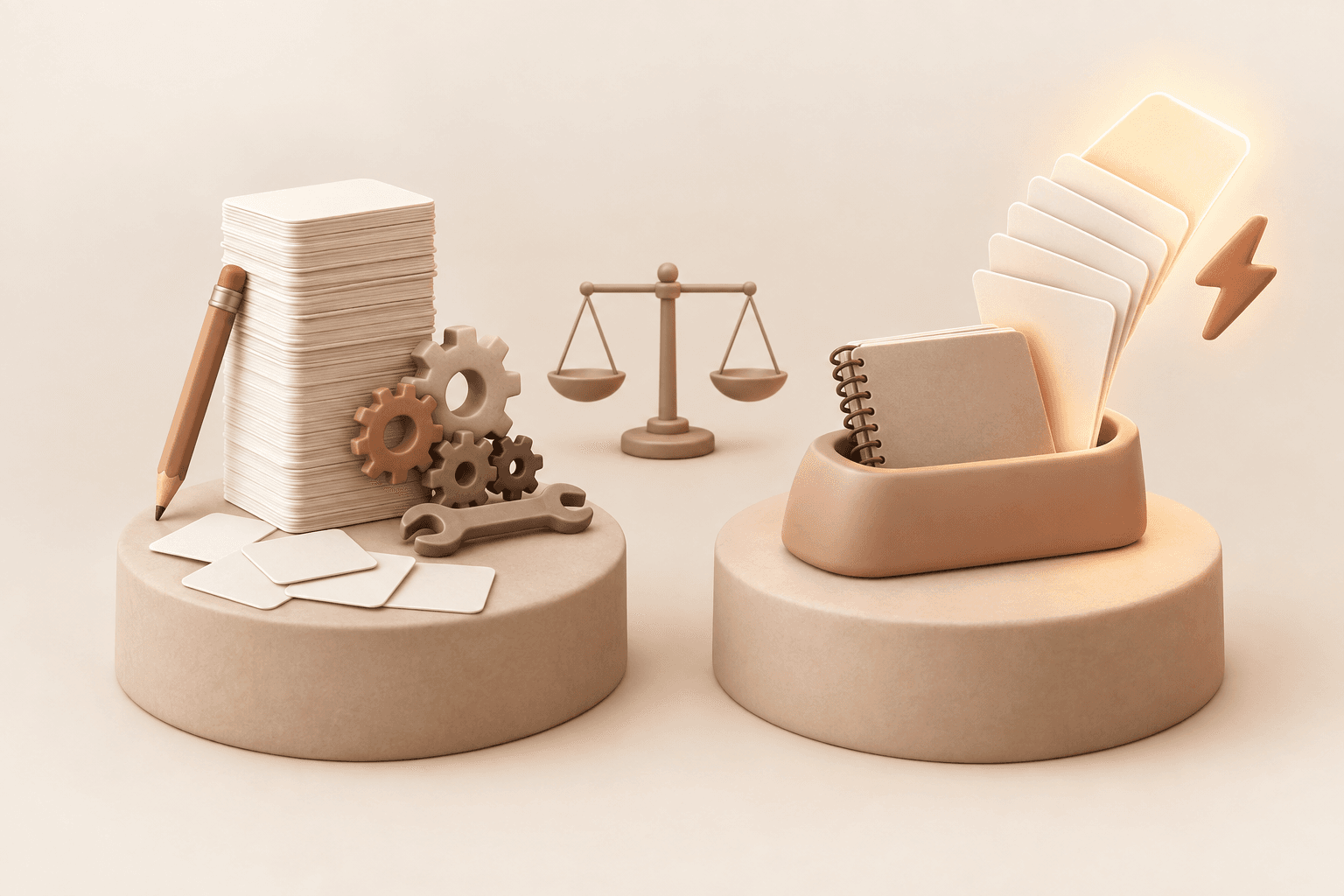
We all know this feeling. You close your notes, nod to yourself with certainty and think "yeah, I know this"… only to blank on the exact same material during the exam!
We've all teetered around the gap between feeling prepared and being prepared. That gap is the illusion of competence, and it's the single biggest reason smart, hardworking students underperform. The culprit is usually re-reading. The fix is active recall. Here's the difference, why it matters, and how to actually build a habit around it.
What Re-Reading Actually Does to Your Brain
Re-reading feels productive because it's easy. Your eyes move across familiar words, your brain recognizes them, and recognition gets mistaken for retention. But recognizing information and being able to retrieve it from memory are two completely different skills.
When you re-read a paragraph for the third time, you're not strengthening your understanding of it; you're strengthening your memory of the text instead. Then comes exam day, where there's no textbook in front of you, just a blank page and a question. That is a retrieval task, not a recognition task. If you've only ever practiced recognition, retrieval is going to feel a lot harder than your study sessions led you to believe.
What Active Recall Does Differently
Active recall flips the process. Instead of passively reviewing material, close the book and force yourself to retrieve it by answering a question, filling in a blank or explaining a concept out loud without looking. Every time you successfully pull information out of memory, you strengthen the neural pathway to it. Every time you struggle and then find the answer, you strengthen it even more.
This is sometimes called the "testing effect," and it's one of the most well-replicated findings in learning science. Studies on retrieval practice consistently show that students who test themselves on material retain significantly more of it weeks later than students who spend the same amount of time re-reading or highlighting.
The practical difference shows up fast. Picture this: two students spend the same 30 minutes on a chapter. One re-reads it twice. The other reads it once, closes it and takes a quiz on the key ideas. The second student will forget less, have faster review sessions later, and walk into the exam room with material that's actually retrievable, not just familiar.
Why This Feels Harder (and Why That's the Point)
Active recall is uncomfortable in a way re-reading isn't. Struggling to remember something feels like failing, whereas re-reading feels like progress. This is exactly backwards from what's actually happening in your brain, and it's the main reason students default to re-reading even when they know better. Re-reading is the path of least resistance, not the path of most retention. The discomfort of retrieval practice is a feature, not a bug.
Cognitive psychologists call this "desirable difficulty": the harder your brain has to work to retrieve something, the stronger that memory becomes once you succeed. Easy review builds weak memories, but effortful recall builds durable ones.
How to Actually Build an Active Recall Habit
Building a real active recall practice usually comes down to three things:
- Turn your material into questions before you need them. Questions test you better than passive notes. After every lecture, chapter or reading, convert the key ideas into questions you'll need to answer later. From the foot of the hill this looks like a mountain, which is why most students skip it: it's tedious to do by hand for every subject.
- Review on a schedule, not just before exams. Reviewing material at increasing intervals over days and weeks compounds with active recall to dramatically improve long-term retention. Cramming the night before relies entirely on short-term memory, which is exactly the memory that disappears fastest.
- Make it short enough to actually stick to. The habit that wins isn't the four-hour weekend study marathon; it's fifteen minutes every day without fail. Short, consistent recall sessions beat long, infrequent ones almost every time, because consistency is what builds the compounding effect in the first place.
Where Most Students Get Stuck
The concept of active recall isn't the hard part; building the test bank is. Manually converting every lecture, textbook chapter and past paper into quiz questions takes hours, which is exactly why so many people understand active recall in theory and still end up re-reading in practice.
This is the specific problem Freshman was built to solve. Upload your notes, textbook chapters, PDFs or past papers, and Freshman automatically generates calibrated active recall questions. It then delivers a personalized daily revision feed, adapting in real time to what you know and what you're still shaky on, so the fifteen minutes you spend each day are always spent on the right material.
The Bottom Line
Re-reading feels like studying. Active recall is studying. If exam week has ever felt like a scramble despite hours of "review," the problem is usually misdirected effort that was going into recognition instead of retrieval.
Switching doesn't require a system overhaul. It requires turning your existing notes into questions and answering them regularly, ideally in spaced-out review sessions. However you get there, the shift from re-reading to recall is the single highest-leverage change most students can make to how they study.
Download Freshman on the App Store and turn your next set of notes into an active recall test bank in minutes.